“We are all connected through food. We are all connected through soil. We are all connected through life. And those are the interconnections that we have to build consciously now” –Dr Vandana Shiva[1]
 The Radical Art of Living: Interview with Dr Vandana Shiva, Navdanya, India, 2024
The Radical Art Of Growing Food
For over twenty years, much of my life and arts practice, has been focused on food systems and the increasingly radical acts of growing organic food, saving seeds and planting trees. The word ‘radical’ originates from the Latin word ‘radix’, meaning ‘root’. I like the idea of getting to the root of complex and interconnected issues in order to achieve the transformation we need to see in our food systems. I believe in the radical art of growing food.
My partner Rena Blake and I live at The Barna Way, an organic farm and creative hub just outside Ballybunion, Co Kerry. We have tried many things to make the farm sustainable with various degrees of success and failure over the years. On our 19 acres we have planted 10,000 trees through the Native Woodland Scheme. We grow organic vegetables and manage meadows for wildlife. We are certified with the Irish Organic Association and are members of Talamh Beo. We are also Farming For Nature Ambassadors and this year we joined their REFARM scheme focused on taking biodiversity actions on our farm. We were delighted to create a Lovelochán this summer, a pond created for wild life in the shape of a heart. We didn’t expect it to fill until Christmas but there has been so much rain that it was full in just four weeks. In fact we could have filled multiple lovelocháns!
I generally try to focus on potential solutions rather that getting bogged down in problems. However in recent times I find it hard not to panic about climate change as I trudge across our fields, wellies half submerged in water, thinking about the 120 million people around the world already displaced due to war, famine and climate chaos[2].
I am concerned about the terrible absurdity of the situation in which we find ourselves in relation to food:
- How have we reached this point where most of the food and seed in the world is controlled by a small number of global corporations?
- Why are most people eating poisoned and ultra-processed food even though we know it is damaging our guts and making us and our loved ones sick?
- Why are we, as an island, so dependent on imported food?
- How can we feed ourselves in increasingly precarious climactic conditions and protect nature at the same time?
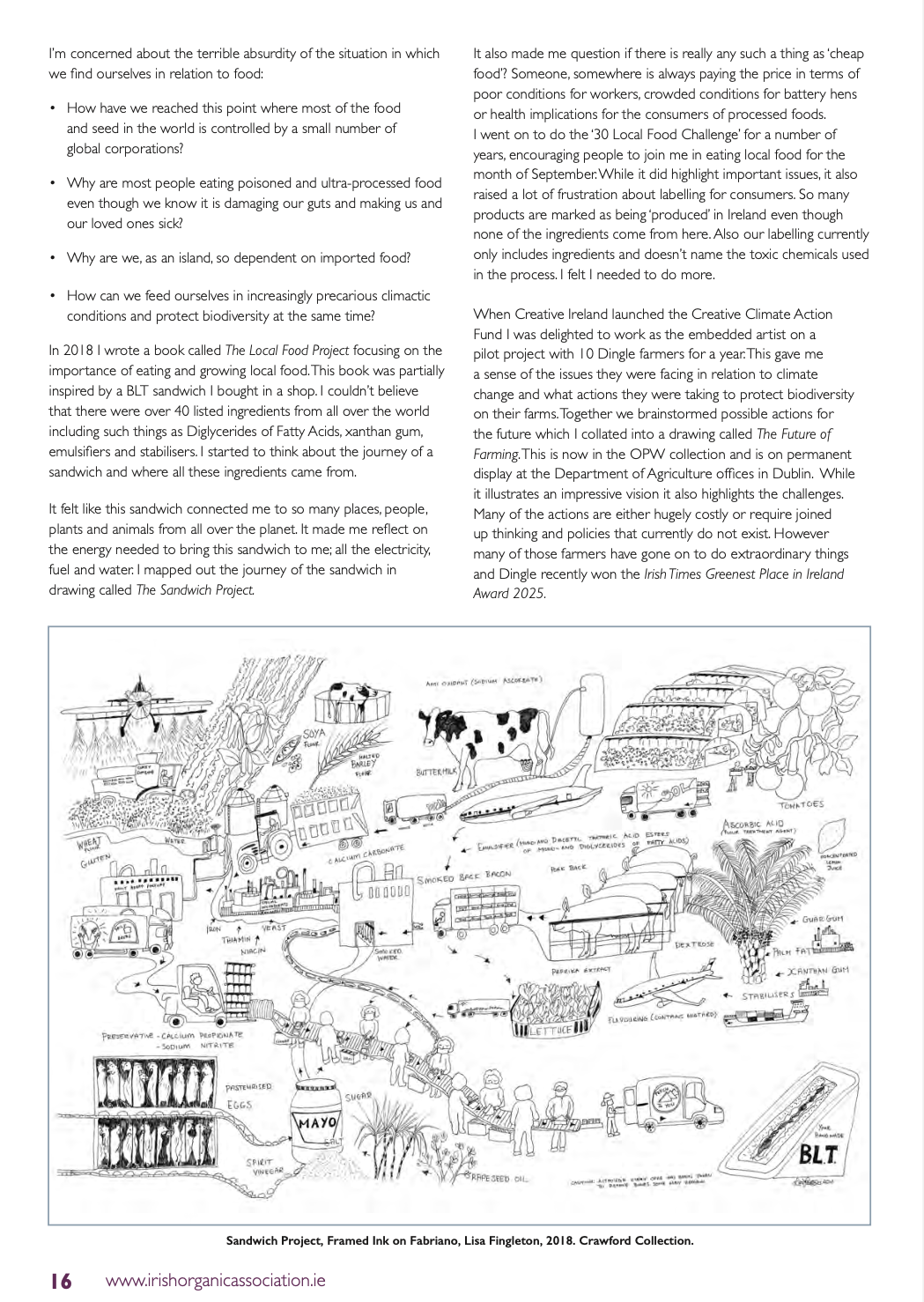
In 2018 I wrote a book called The Local food Project focusing on the importance of eating and growing local food. This book was partially inspired by a BLT sandwich I bought in a shop. I couldn’t believe that there were over 40 listed ingredients from all over the world including such things as Diglycerides of Fatty Acids, xanthan gum, emulsifiers and stabilisers. I started to think about the journey of a sandwich and where all these ingredients came from.
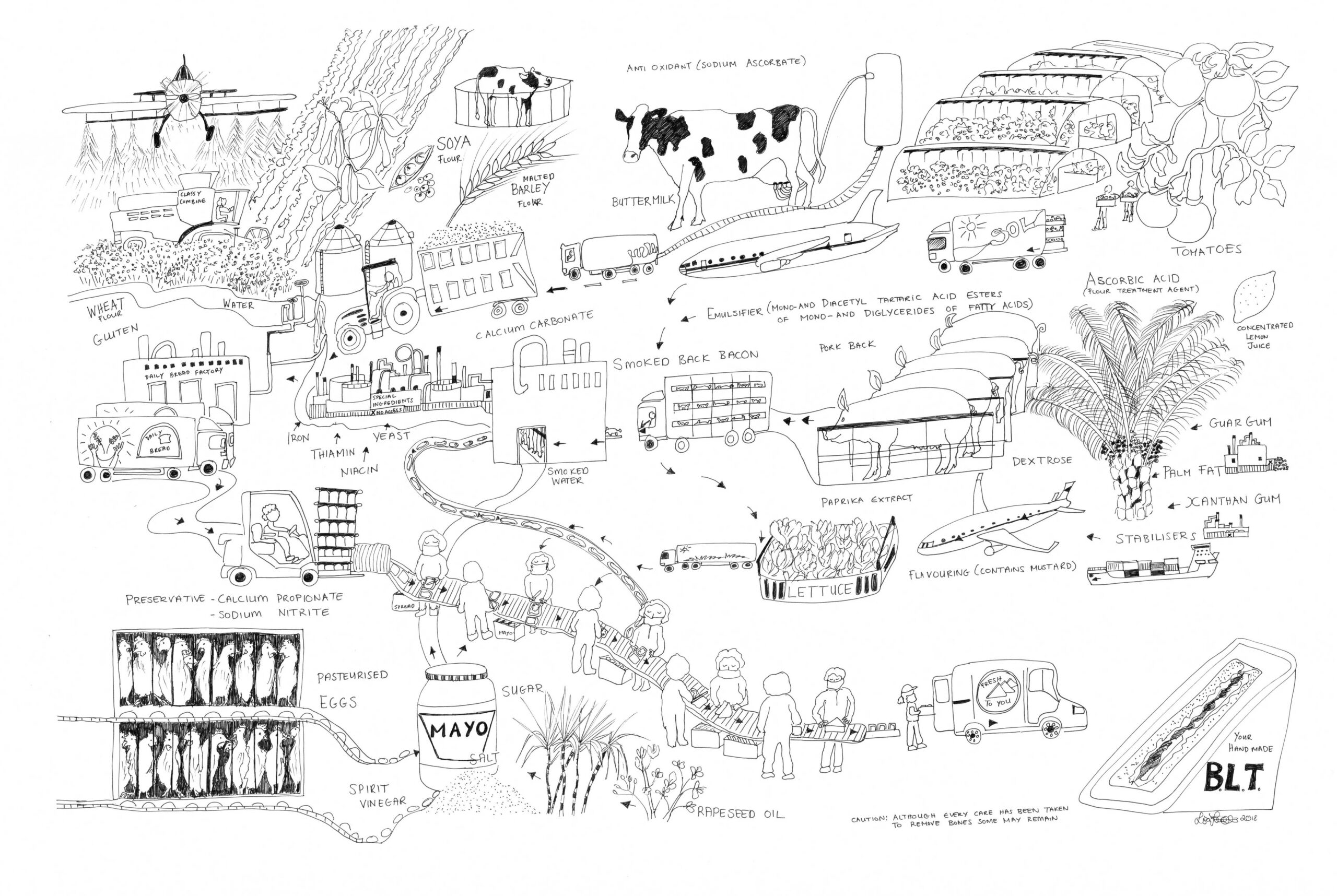 The Sandwich Project, Ink on Paper, 2018 (Crawford Collection)
It felt like this sandwich connected me to so many places, people, plants and animals from all over the planet. It made me reflect on the energy needed to bring this sandwich to me; all the electricity, fuel and water. I mapped out the journey of the sandwich in drawing called The Sandwich Project.
It also made me question if there is really any such a thing as ‘cheap food’? Someone, somewhere is always paying the price in terms of poor conditions for workers, crowded conditions for battery hens or health implications for the consumers of processed foods.
I went on to do the 30 Local Food Challenge’ for a number of years, encouraging people to join me in eating local food for the month of September. This work was showcased at an exhibition called Holding True Ground in Siamsa Tire in 2015. While it did highlight important issues, it also raised a lot of frustration about labelling for consumers. So many products are marked as being ‘produced’ in Ireland even though none of the ingredients come from here. Also our labelling currently only includes ingredients and doesn’t name the toxic chemicals used in the process. I felt I needed to do more.
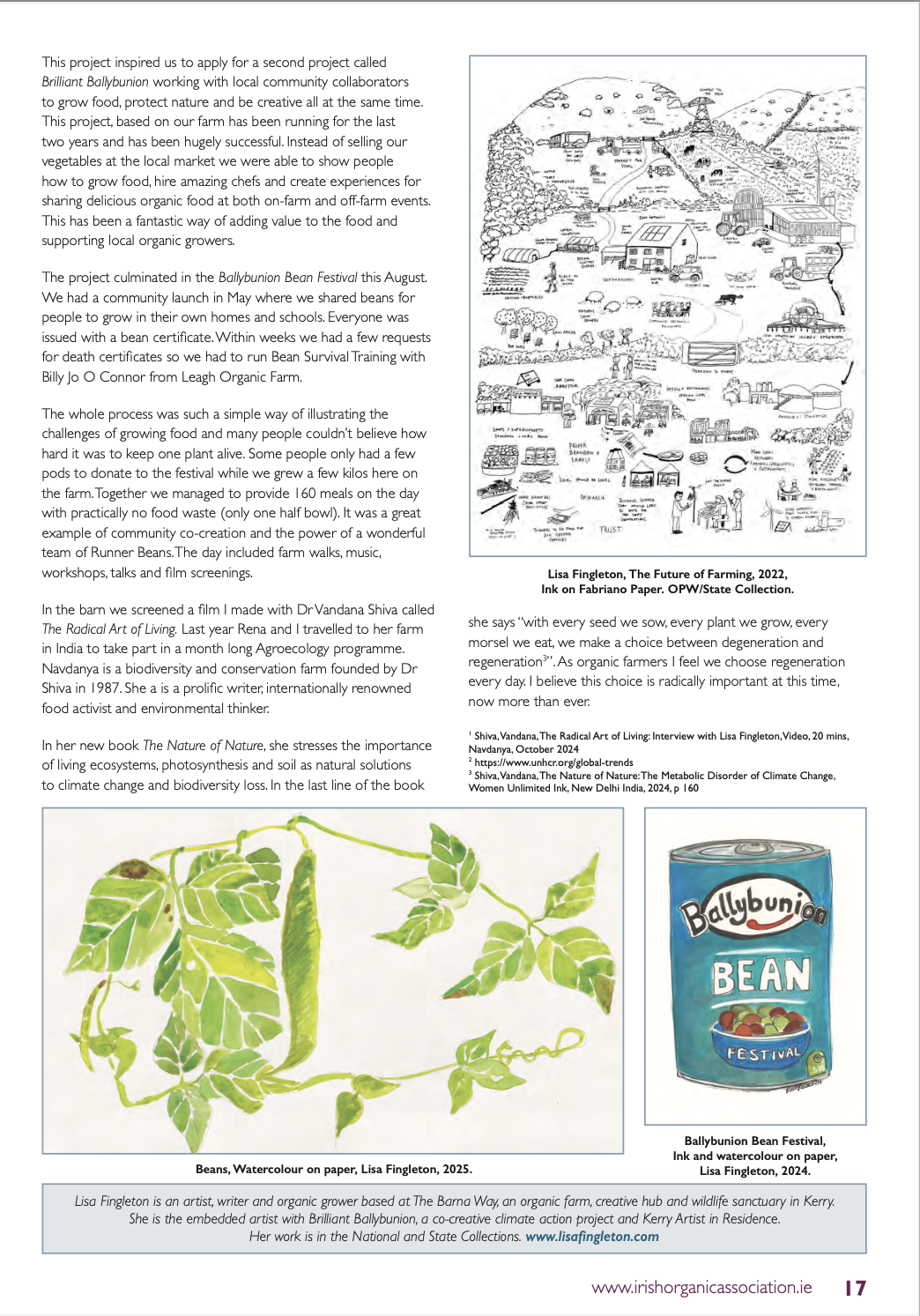
When Creative Ireland launched the Creative Climate Action Fund I was delighted to work as the embedded artist on a pilot project with 10 Dingle farmers for a year. This gave me a sense of the issues they were facing in relation to climate change and what actions they were taking to protect biodiversity on their farms. Together we brainstormed possible actions for the future which I collated into a drawing called The Future of Farming. This is now in the OPW collection and is on permanent display at the Department of Agriculture offices in Dublin. While it illustrates an impressive vision it also highlights the challenges. Many of the actions are either hugely costly or require joined up thinking and policies that currently do not exist. However many of those farmers have gone on to do extraordinary things and Dingle recently won the Irish Times Greenest Place in Ireland Award 2025. We did a huge drawing together at the National Ploughing Championship called the Creative Climate Wall and also made a series of films called Voices From The Field.

The Future of Farming, Ink on Paper, 2023 (OPW Collection)
This project inspired us to apply for a second project called Brilliant Ballybunion working with local community collaborators to grow food, protect nature and be creative all at the same time. This project, based on our farm has been running for the last two years and has been hugely successful. Instead of selling our vegetables at the local market we were able to show people how to grow food, hire amazing chefs and create experiences for sharing delicious organic food at both on-farm and off-farm events. This has been a fantastic way of adding value to the food and supporting local organic growers. We also had an exhibition called The Square Tomato at Siamsa Tire, Tralee which was attended by thousands of people and was named as one on the Top Ten Exhibitions Of The Year by the Irish Times. Writer Gemma Tipton wrote a very insightful article about the exhibtion called Square Roots.
“The challenges we face are interconnected, but just as pollutions and poisons flow into the threaded networks of roots and the trickling tributaries of the water table, this exhibition opens up another set of networks. As Fingleton explores, a line of defence against the infinitely sophisticated manipulations of corporate communications lies with the equally infinite opportunities of art. Running counter to the narrative that claims it is too late and that there is nothing now to be done, there is instead always a new alternative to explore”. -Gemma Tipton
We also published a book called What If We Were Brilliant? so that we could share the journey of the project and all our learning along the way. President Connolly came to our celebration In Janaury this year. She said “the solutions are on the ground and all we need to do is give recognition to those community groups and resource them, enable them and recognise them and therein is our future both local and global’.
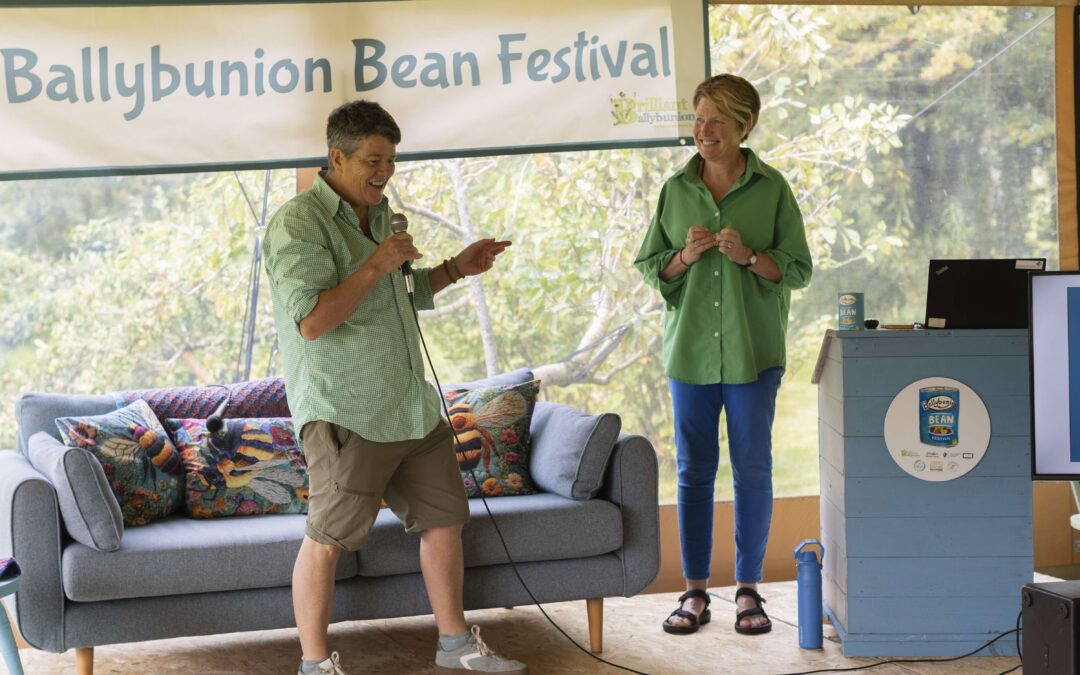
Another highlight of the project was the Ballybunion Bean Festival last August. We had a community launch in May where we shared beans for people to grow in their own homes and schools. Everyone was issued with a bean certificate. Within weeks we had a few requests for death certificates so we had to run Bean Survival Training with Billy Jo O Connor from Leagh Organic Farm.
The whole process was such a simple way of illustrating the challenges of growing food and many people couldn’t believe how hard it was to keep one plant alive. Some people only had a few pods to donate to the festival while we grew a few kilos here on the farm. Together we managed to provide 160 meals on the day with practically no food waste (only one half bowl). It was a great example of community co-creation and the power of a wonderful team of Runner Beans. The day included farm walks, music, workshops, talks and film screenings.
In the barn we screened a film I made with Dr Vandana Shiva called The Radical Art of Living. Last year Rena and I travelled to her farm in India to take part in a month long Agroecology programme. Navdanya is a biodiversity and conservation farm founded by Dr Shiva in 1987. She a is a prolific writer, internationally renowned food activist and environmental thinker.
In her new book The Nature of Nature, she stresses the importance of living ecosystems, photosynthesis and soil as natural solutions to climate change and biodiversity loss. In the last line of the book she says “with every seed we sow, every plant we grow, every morsel we eat, we make a choice between degeneration and regeneration[3]”.
As organic farmers I feel we choose regeneration every day. I believe this choice is radically important at this time, now more than ever.
_________________
The Ballybunion bean Festival will take place on 22nd/23rd August 2026
[1] Shiva, Vandana, The Radical Art of Living: Interview with Lisa Fingleton, Video, 20 mins, Navdanya, October 2024
[2] https://www.unhcr.org/global-trends
[3] Shiva, Vandana, The Nature of Nature: The Metabolic Disorder of Climate Change, Women Unlimited Ink, New Delhi India, 2024, p 160
This original article was commissioned by the Irish Organic Association.